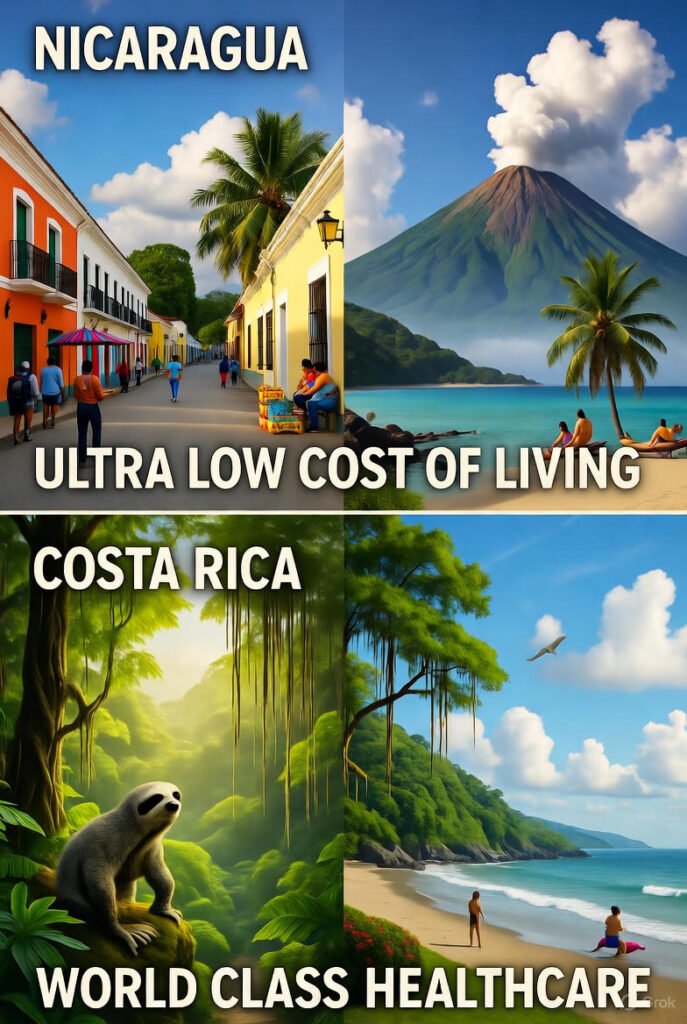
Nicaragua vs Costa Rica for Expats: Cost, Residency and Safety Compared

Nicaragua and Costa Rica are neighbours with contrasting vibes. Both offer Central America's tropical allure, but one delivers budget-friendly authenticity amid political challenges, while the other provides eco-luxury and stability — at a meaningfully higher price, though not the double often claimed. Use this guide to decide your "Pura Vida" paradise, with every residency, tax, currency and safety figure verified and sourced.

The short answer. Nicaragua costs meaningfully less — published estimates put a couple at $1,400–$2,400 a month against $2,200–$3,200 in Costa Rica, rising past $3,000 in the popular beach towns. Costa Rica offers the stronger institutions: a territorial tax system that exempts foreign income, universal healthcare covering over 90% of the population, and a fourth-place finish in the World Happiness Report 2026 — its highest ever, and the first time a Latin American country has entered the global top five.

On safety, the popular assumption is wrong. Costa Rica recorded 872 homicides in 2025, a rate of about 16.4 per 100,000 — among the higher rates in Central America, driven by cocaine-trafficking violence. Nicaragua publishes no independently verifiable figures, so the two cannot be honestly compared.

How do Nicaragua and Costa Rica compare for expats?

Nicaragua vs Costa Rica at a glanceResidency, tax, currency and safety figures verified July 2026. Cost-of-living figures are published expat estimates and vary by source and location. All sources listed at the end of this page.
Category🇳🇮 Nicaragua🇨🇷 Costa Rica
StandingNot ranked in the InterNations Expat Insider 2025 survey. Affordable and authentic, but political instability lingers after the 2018 unrest.4th in the World Happiness Report 2026 — its best result ever, and the first Latin American country in the global top five. Eco-leader, stable democracy, no standing army since 1948. Not ranked in the InterNations Expat Insider 2025 survey either — that survey's top three were Panama, Colombia and Mexico.
Residency EasePensionado: $1,000/month pension
Rentista: $1,250/month income
Investor: $30,000+ in property, business, agriculture or forestry Processed directly through Migración since Law 1210, August 2024, which replaced the old two-step INTUR route.
Pensionado: $1,000+/month lifetime pension → two-year renewable
Rentista: $2,500/month stable income for two years Both are temporary categories that can lead to permanent residency after the required period. Pensionado has no minimum age.
Digital Nomad VisaNone dedicated. Rentista is the route for remote workers.1 year, renewable once. Requires $3,000+/month in foreign-sourced income. Not residency — it is an estancia category and does not lead to permanent residency.
Cost of Living (couple)$1,400–$2,400/month depending on location — León among the cheapest, San Juan del Sur among the priciest.$2,200–$3,200/month for a typical couple, or $2,500–$3,500 with a car and private healthcare. Beach towns such as Tamarindo start nearer $3,000.
Groceries (monthly)$150–$300. Local markets slash costs; fresh produce abundant.$350–$500. Organic focus; farmers' markets are cheaper.
Rent (1-bed, modern)Granada: $300–$500
San Juan del Sur: $400–$700
Escazú: $800–$1,200
Tamarindo: $1,200–$2,000
HealthcarePublic: basic and low-cost, $5–$15 per visit, but with shortages. Private: 50–70% below US prices; English mainly in Managua.CAJA public system — contributions run 7–11% of declared income, so roughly $65/month on a $1,000 Pensionado income and around $200/month on a $2,500 Rentista income. Covers over 90% of the population, including pre-existing conditions, with no co-pays. Private care runs 60–70% cheaper than the US. Enrolment is mandatory for every legal resident. Because the fee scales with declared income, higher earners pay considerably more than a flat range suggests.
Internet50–100 Mbps at $30–$50/month. Reliable in expat hubs.50–300 Mbps at $35–$60/month.
CurrencyCórdoba (C$ / NIO) — C$36.62 = $1, fixed since January 2024 when the crawling devaluation was stopped. Stable but cash-heavy.Colón ( / CRC) — about ₡454 = $1 in July 2026, having strengthened from roughly ₡500 earlier in the year. Local transfers are easy via SINPE Móvil.
TaxesNo tax on foreign income. Retiree import exemptions previously granted under Law 694 are not listed here: Law 694 was repealed in full on 2 August 2024. Confirm current status with a Nicaraguan immigration lawyer.Territorial tax system — foreign-source income is exempt regardless of residency, including foreign pensions, overseas investments and salary for work performed abroad. Capital gains are taxed at a flat 15%, with the sale of a primary residence exempt.
Best for RetireesGranada and San Juan del Sur — colonial charm, beaches, low-key communities.Central Valley and Arenal — mild climate, nature, international schools.
Best for Beach LifeSan Juan del Sur and the Corn Islands — surf, Caribbean vibes, uncrowded.Guanacaste and Nicoya — Pacific surf, yoga, and one of the world's recognised Blue Zones.
Urban Expat SceneGranada and León — colonial history, walkable, but less cosmopolitan.San José metro — malls, public transport, English widespread.
Nature & BiodiversityVolcanoes including Cerro Negro, Lake Nicaragua, rainforest — adventure-focused.26.5% of land is protected (World Bank, 2024) — sloths, volcanoes, cloud forests.
WeatherDry November–April; rainy May–October. Hot in the Pacific lowlands, 85–90°F.Green season brings lower prices. Central Valley sits at 70–80°F year-round.
SafetyNo independently verifiable homicide figure exists — Nicaragua does not publish transparent statistics, and InSight Crime excludes it from regional analysis for that reason. Expat areas are generally calm; vigilance is still sensible. A direct murder-rate comparison between the two countries cannot honestly be made.872 homicides in 2025 — about 16.4 per 100,000, roughly level with 2024 and among the higher rates in Central America. Around two-thirds are tied to gang conflict over cocaine trafficking routes. Expat areas remain comparatively calm, with petty theft the usual concern in tourist spots.
Pro TipSpanish fluency is key for real immersion.Use SINPE Móvil for instant local transfers, and a 4x4 for rural driving.

Which one should you choose?

Choose Nicaragua if you want

Ultra-low costs, authentic culture, volcano adventures and off-grid freedom — ideal for budget retirees or those seeking a slower, less developed pace.

Choose Costa Rica if you want

World-class healthcare, eco-immersion, institutional stability and vibrant expat hubs — well suited to families and nature lovers who can absorb the higher cost.

Frequently asked questions

Is Nicaragua or Costa Rica cheaper for expats?

Nicaragua is cheaper. Published estimates put a couple at $1,400–$2,400 a month in Nicaragua against $2,200–$3,200 in Costa Rica, rising past $3,000 in popular beach towns. Rent shows the widest gap: Granada runs $300–$500 for a one-bedroom, while Tamarindo reaches $1,200–$2,000.

Is Costa Rica safer than Nicaragua?

That comparison cannot honestly be made. Costa Rica recorded 872 homicides in 2025, about 16.4 per 100,000, with two-thirds tied to cocaine-trafficking gang conflict. Nicaragua does not publish independently verifiable crime statistics. Expat areas in both countries are comparatively calm.

What are Costa Rica's residency requirements?

Pensionado requires a lifetime pension of $1,000 or more per month, with no minimum age. Rentista requires $2,500 per month in stable income for two years. Both are temporary categories that can lead to permanent residency. The digital nomad visa needs $3,000 per month but is not residency.

Does Costa Rica tax foreign income?

No. Costa Rica uses a territorial tax system, so foreign-source income is exempt regardless of residency status — including foreign pensions, overseas investment returns and salary for work performed outside the country. Capital gains are taxed at a flat 15%, with a primary residence exempt.

Is Costa Rica really the happiest country in Latin America?

By one widely cited measure, yes. Costa Rica placed fourth in the World Happiness Report 2026 — its highest ever, and the first time a Latin American country has entered the global top five, behind only Finland, Iceland and Denmark. It scores strongly on social support and perceived freedom.

Weighing up a move? We'll connect you with vetted lawyers, accountants and advisors on the ground.

Find a professional — free for expats

Sources

Residency, tax, currency, healthcare and safety figures verified July 2026. Immigration and tax rules change without notice — confirm with a licensed professional before acting on anything here. This is information, not legal or financial advice.

Trusted specialists

Need help in Nicaragua? Find a vetted professional.

Connect with an English-speaking, ECS-verified specialist — lawyers, doctors, advisors and property experts who know the system.

Find a professional →