
In the heart of Nicaragua, where the jagged peaks of the Chontales mountains meet the vast cattle ranching plains, lies the village of San Francisco de Cuapa. For centuries, it was a place of quiet labor and dust. However, in 1980, against the backdrop of a nation torn by revolution and impending civil war, this remote outpost became the site of one of the few Vatican-approved Marian apparitions of the 20th century.
Part I: The Heavenly Narrative (1980)
The Visionary: Bernardo Martínez
The story begins not with a mystic or a scholar, but with a humble sacristan named Bernardo Martínez. In 1980, Bernardo was nearly 50 years old. He lived a life of extreme simplicity, tending to the local chapel, ringing the bells for prayer, and living in a state of “holy poverty.” He was a man of deep faith but little worldly influence, making him the quintessential “quiet soul” through which such messages often arrive.
The Five Apparitions
The events unfolded in a series of supernatural encounters between April and October of 1980:
- The Luminous Statue (April 15): The first sign was subtle. While cleaning the chapel, Bernardo saw the statue of the Virgin Mary glowing with a supernatural light. Fearing people would think him mad, he kept silent, even avoiding the church for several days.
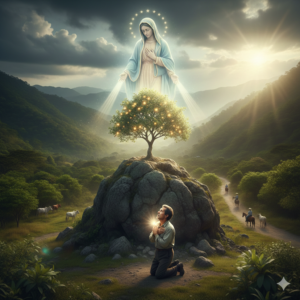
- The First Vision at La Piedra (May 8): While returning from fishing, Bernardo saw two flashes of lightning. Near a large rock formation (La Piedra), he saw a woman standing on a cloud atop a small citrus tree. She identified herself as “The Mother of Jesus” and asked for the daily recitation of the Rosary, emphasizing that it should be prayed with “the Word of God” (scripture) and not just as a repetitive habit.
- The Vision of the Saints (June 8): Mary appeared again, showing Bernardo a “celestial movie.” He saw a procession of people in white robes—saints and religious figures—praying the Rosary. This taught Bernardo that prayer is a bridge connecting the living with the eternal.
- The Plea for Peace (September 8): As political tensions in Nicaragua escalated, the Virgin appeared as a young girl. When Bernardo suggested building a grand cathedral in her honor, she gave a corrective message that remains the hallmark of Cuapa: “The Lord does not want material churches. He wants living temples, which are yourselves.”
- The Final Farewell (October 13): On the anniversary of the miracle at Fatima, Mary appeared for the last time. She wept as she looked upon the world, warning that Nicaragua would suffer greatly if its people did not seek internal reconciliation. Her final words were a challenge: “Do not ask for peace without making peace.”
Part II: The Geography of Grace (Location & Site)
The apparition site is not a polished, gold-plated basilica. It remains true to the rural, rugged character of the Nicaraguan “campo.”
1. The National Sanctuary of Our Lady of Cuapa
Located in the Department of Chontales, the sanctuary is an open-air complex built around the natural features of the mountain.
- La Piedra (The Rock): This is the heart of the pilgrimage. It is a massive, dark volcanic rock where the Virgin stood. Today, a simple altar is built at its base. Pilgrims often touch the rock while praying, seeking a physical connection to the site of the miracle.
- The Chapel of the Glow: Back in the town center of San Francisco de Cuapa, you can visit the small, rustic church where the statue first emanated light. It remains a place of intense, quiet devotion.
- The Way of the Cross: A steep, winding path leads from the town up to the Rock. It is lined with the Stations of the Cross, and it is common to see pilgrims ascending this path on their knees as an act of “promesa” (a solemn vow or penance).
2. The Surrounding Landscape
Chontales is known as the “land of milk and honey” in Nicaragua. The drive to Cuapa offers stunning views of:
- Amerrisque Mountains: Ancient, jagged peaks that dominate the horizon.
- Cattle Ranches: You will pass traditional Nicaraguan vaqueros (cowboys) herding Brahman cattle.
- Local Flora: The “sacuanjoche” (national flower) and citrus trees, similar to the one Mary stood upon, dot the landscape.
Part III: Travel Guide from Managua
Reaching Cuapa requires a journey of approximately 150 kilometers (93 miles), taking you from the bustling capital into the tranquil highlands.
Directions & Logistics
- By Car: Take the NIC-7 (Carretera al Rama) heading east. You will pass through the towns of Tipitapa and San Benito.
- The Juigalpa Turn-off: Upon reaching the city of Juigalpa (the capital of Chontales), you will turn north toward San Francisco de Cuapa. This final leg of the journey is roughly 25-30 minutes through winding, scenic roads.
- Travel Time: Total driving time is roughly 2 hours and 50 minutes, depending on traffic and road conditions.
- Best Time to Visit: * May 8th: The Anniversary of the first apparition. This is the busiest day of the year, with tens of thousands of pilgrims.
- Dry Season (Nov–April): The roads are easiest to navigate, and the views of the mountains are clearest.
Tips for Pilgrims
- Attire: Wear sturdy walking shoes and modest clothing suitable for a religious site. The sun in Chontales is intense, so bring a hat and water.
- Lodging: While Cuapa has very limited facilities, the nearby city of Juigalpa offers several comfortable hotels and traditional Nicaraguan restaurants serving famous Chontales steaks and cheese.
- Spirituality: Bring a Rosary and a Bible. The core message of Cuapa is to meditate on the scriptures while praying.
Part IV: The Legacy of Bernardo Martínez
Bernardo’s story did not end in 1980. To protect him from political exploitation during the Contra War, the Church moved him to the city of Leon. He eventually answered a late-life calling to the priesthood and was ordained in 1995.
Until his death in 2000, Father Bernardo remained a man of profound humility. He never sought wealth or fame from his visions. He lived as he preached—as a “living temple.” Today, his tomb in the Cathedral of Leon is also a site of visitation for those who followed his journey from a simple sacristan to a messenger of peace.
Summary Table for Visitors
| Feature | Detail |
| Primary Location | San Francisco de Cuapa, Chontales, Nicaragua |
| Distance from Managua | 150 km (approx. 2h 50m drive) |
| Visionary | Father Bernardo Martínez |
| Church Status | Formally approved by the Catholic Church |
| Key Message | “Do not ask for peace without making peace.” |
| Main Feast Day | May 8th |