Nicaragua Augusto C. Sandino Airport Expansion: Bigger Runways, Bigger Planes.
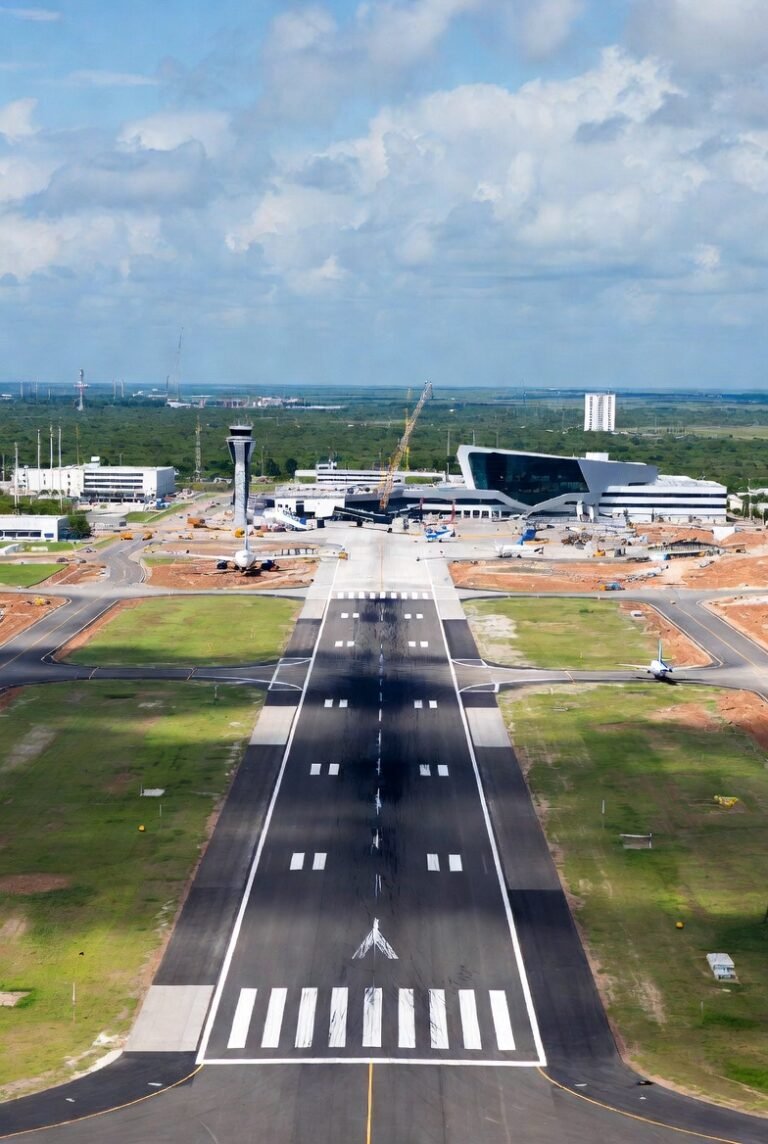
Nicaragua’s Airport Expansion: What’s Actually Being Built, and What It Costs
Runway specifications, contractor names, investment figures, trade-agreement dates and 2025 export values were verified in July 2026 against the sources linked at the end of this article. Where a completion date or a projected benefit could not be confirmed from a reliable source, it has been left out rather than estimated. Infrastructure timelines slip routinely; treat all forward dates as targets.
Nicaragua is rebuilding its aviation infrastructure with Chinese money and Chinese contractors, and the plan is more concrete than the coverage usually suggests. Here is what is actually under construction, who is paying for it, and where the numbers being repeated online do not hold up.
The short answer. Two projects are running. Managua’s Augusto C. Sandino International is being upgraded from category 4D to 4E — the runway extended by 858 metres to 3,300 metres — at a cost of USD 55.3 million, built by China State Construction Engineering Corporation. Separately, a much larger airport at Punta Huete is being built by China CAMC Engineering on a USD 400.5 million credit, with a 3,600-metre category 4F runway and completion targeted for late 2029.
The 4E upgrade is what allows wide-body aircraft such as the Boeing 787 and Airbus A350 to operate from Managua, which is the precondition for any non-stop service to Europe or Asia. The commercial case rests on the China trade agreement that took effect on 1 January 2024.
What is being built at Managua’s airport?
The work at Augusto C. Sandino International is a runway and taxiway project rather than a new terminal. The main runway is being extended by 858 metres to a total of 3,300 metres, taking the airport’s classification from category 4D to category 4E.
That code matters more than it sounds. ICAO aerodrome reference codes describe what an airport can physically accept. 4E is the category that admits wide-body aircraft such as the Boeing 787 and Airbus A350 — longer-range types that can reach Europe or Asia without an intermediate stop. Until the upgrade completes, Managua simply cannot handle them.
The contractor is China State Construction Engineering Corporation (CSCEC), one of China’s largest state-owned builders. The government allocated USD 55.3 million to the expansion, with work reported as underway during early 2026.
What is Punta Huete, and how does it compare?
Punta Huete is the larger of the two projects and the one that would genuinely change Nicaragua’s position in the region. It sits in the municipality of San Francisco Libre, and it is being built by China CAMC Engineering.
| Augusto C. Sandino (Managua) | Punta Huete | |
|---|---|---|
| Type of work | Upgrade of an operating airport | New-build airport |
| Runway | Extended 858 m to 3,300 m total | 3,600 m |
| Category | 4D upgrading to 4E | 4F — the highest ICAO code |
| Contractor | China State Construction Engineering Corporation | China CAMC Engineering |
| Cost | USD 55.3 million | USD 400.49 million credit (CNY 2.87 billion) |
| Capacity target | Not stated in available sources | 3.5 million passengers per year |
| Completion target | Not confirmed in available sources | End of 2029 (August 2029 cited) |
Category 4F is the top of the ICAO scale — the class that accommodates the very largest aircraft in service. Building to 4F in a country of Nicaragua’s traffic volume is a statement of intent about freight and regional hub ambitions rather than a response to existing passenger demand.
Why is China funding Nicaragua’s airports?
The commercial logic runs through the trade agreement, and the timeline is worth stating plainly.
Nicaragua switched diplomatic recognition from Taiwan to the People’s Republic of China in December 2021. A free trade agreement followed: signed on 31 August 2023 and in force from 1 January 2024. Around 60% of goods in bilateral trade became tariff-free immediately, with tariffs on more than 95% scheduled to fall to zero over time.
For Nicaragua the relevant detail is on the export side. The agreement frees 71% of Nicaraguan products sent to China from tariffs — explicitly including fish, shrimp, lobster and sea cucumber. Those are high-value perishables, and perishables are the cargo category where air freight beats sea freight on economics rather than just on speed.
What does Nicaragua actually export?
The scale is worth having accurately, because it sets the ceiling on what air cargo capacity can plausibly be worth.
Nicaragua’s total exports reached USD 8.91 billion in 2025, up USD 1.19 billion or 15.4% on 2024.
- Gold — the top export, more than USD 1 billion ahead of both beef and coffee, driven by a 41.8% rise in the average gold price over the year
- Coffee — USD 1.32 billion, among the fastest-growing categories
- Beef — USD 927 million
- Seafood — lobster prominent by volume, and the category most directly affected by the China tariff exemptions
Note what that mix implies. Gold does not need a wide-body freighter. Coffee travels perfectly well by sea. The export categories that genuinely benefit from air capacity are the seafood lines — which is precisely where the trade agreement concentrated its tariff relief, and a reasonable read of why the airport programme and the FTA arrived together.
What are the risks?
Three, and they are not trivial.
The debt is real even if it is not billions. Roughly USD 456 million across the two projects is meaningful for an economy of Nicaragua’s size, and it is owed to Chinese state-linked lenders. The wider record of Chinese infrastructure lending in Latin America includes projects that did not deliver the promised returns.
Capacity is being built ahead of demand. Punta Huete targets 3.5 million passengers a year. Nicaragua’s passenger traffic has not been growing at a rate that would fill that, and infrastructure built on projected rather than observed demand is how airports end up underused.
Routes are not guaranteed by runways. A 4E-capable runway makes non-stop service to Europe or Asia physically possible. It does not make any airline choose to fly it. Route decisions follow demand, bilateral agreements and aircraft availability — and no carrier has announced such a service.
What does this mean if you live in Nicaragua?
In the near term, very little changes. Nothing here alters flight options this year or next.
If the Managua upgrade completes and a carrier does take up a long-haul route, the practical effect for residents would be the removal of a connection — currently Miami, Houston, Panama City or Madrid for most European journeys. That is a real quality-of-life improvement for anyone flying to Europe regularly, and it is the single change most worth watching.
But it depends on an airline decision that has not been made, following a construction completion that has not been dated. We will update this page when either changes.
Frequently asked questions
What is being built at Managua airport?
The main runway at Augusto C. Sandino International Airport is being extended by 858 metres to a total of 3,300 metres, upgrading the airport from ICAO category 4D to category 4E. The contractor is China State Construction Engineering Corporation and the government allocated 55.3 million US dollars to the project.
Will Nicaragua get direct flights to Europe?
It becomes physically possible, but no airline has announced such a service. The category 4E upgrade allows wide-body aircraft such as the Boeing 787 and Airbus A350 to operate from Managua, which is a precondition for non-stop long-haul flights. Whether any carrier chooses to fly the route depends on demand, bilateral agreements and aircraft availability.
When will Punta Huete airport open?
Completion is targeted for the end of 2029, with August 2029 cited in project reporting. Punta Huete is being built by China CAMC Engineering under a credit of 400.49 million US dollars, with a 3,600-metre category 4F runway and a stated capacity of 3.5 million passengers per year.
How much are Nicaragua's airport projects costing?
Roughly 456 million US dollars in total across both projects: 55.3 million for the Managua runway upgrade and 400.49 million in credit for the new airport at Punta Huete. Figures circulating that describe the cost as billions of dollars are not supported by the available sources.
When did the Nicaragua China free trade agreement take effect?
It was signed on 31 August 2023 and entered into force on 1 January 2024. Around 60 percent of goods in bilateral trade became tariff-free immediately, and 71 percent of Nicaraguan products sent to China are exempt from tariffs, including fish, shrimp, lobster and sea cucumber.
What are Nicaragua's biggest exports?
Total exports reached 8.91 billion US dollars in 2025, up 15.4 percent on the previous year. Gold is the largest single export by value, more than 1 billion dollars ahead of both beef and coffee. Coffee reached 1.32 billion dollars and beef 927 million dollars.
Watching Nicaragua for the right reasons? Start with people who live here.
Browse the directorySources
- EAAI (Nicaraguan airports authority): Managua prepares for transatlantic flights — runway extension of 858 m to 3,300 m, 4D to 4E upgrade, CSCEC as contractor
- Infobae, February 2026: Nicaragua allocates USD 55.3 million to the Sandino expansion — investment figure and contractor
- CAPA Centre for Aviation: Punta Huete Airport project profile — 3,600 m runway, 3.5 million passenger capacity, CNY 2.87 billion / USD 400.49 million credit, China CAMC Engineering, completion target
- China–Nicaragua free trade deal to take effect 1 January 2024 — signature and entry-into-force dates, tariff coverage
- SeafoodSource: China–Nicaragua FTA now in effect — 71% of Nicaraguan exports tariff-free, seafood categories covered
- Confidencial: Gold and coffee drive Nicaragua’s exports past USD 8 billion in 2025 — total export value, growth rate, product breakdown
- Divergentes: Inside China’s development narrative in Nicaragua — critical context on Chinese infrastructure lending in the region
Need help in Nicaragua? Find a vetted professional.
Connect with an English-speaking, ECS-verified specialist — lawyers, doctors, advisors and property experts who know the system.
Find a professional →